Monday, October 7, 2013

Tianlang Guan still alive at the Masters despite being on the wrong end of a horrible call


Tianlang Guan still alive at the Masters despite being on the wrong end of a horrible call


Dan Wetzel April 12, 2013 9:30 PMYahoo Sports


AUGUSTA, Ga. – Tianlang Guan approached his soon-to-be infamous second shot on the 17th fairway of Augusta National and found company. Ben Crenshaw's ball was a few yards back and to the right. Matteo Manassero's was a little ahead and to the left.

Which ball was which was, perhaps, confusing. Guan appeared concerned about violating one of golf's key rules: You can only play your own ball. The problem was, his ball landed with its logo face down into grass, making easy identification impossible.

Since another rule says you can't pick up or move the ball – even slightly – he crouched down multiple times, even going to all fours, in attempt to look under the ball and make sure he had the right one. Then he did it again, even if Crenshaw and Manassero expressed no such concern over where they landed.

The 14-year-old from China, the youngest player to ever compete in the Masters, was in position to do what many believed impossible – make the cut.

And he was leaving nothing to chance. Nothing. Not even an obvious thing like this.

These attributions of precision, patience and, indeed, pace – not to mention a delicate short game – are what eventually got him to the promised land of the weekend of the Masters.


[Related: Players rip decision to penalize Guan]

It is also what nearly cost him the entire thing.


View gallery.

Tianlang Guan acknowledges the crowd's applause after making a putt on the second green at Augusta National. (Getty …Just moments after making sure that he had the right ball, throwing grass into the air to check the wind, walking up the hill to get a look at the green and then switching clubs, Guan was penalized a stroke for slow play. Official John Paramor, who earlier had issued two other direct warnings to Guan, ran a stopwatch on him that exceeded the minimum 40-second time limit.


A slow play penalty is so rare the Masters said it had no record of any others ever issued. It's occurred just three other times in the last 16 years of major tournaments and not for years in regular PGA Tour events. The penalty pushed Guan to 3-over on the day and 4-over for the tournament. He only made the cut because leader Jason Day's birdie putt on 18 went just left of the hole.

"I respect the decision," Guan said later of the penalty.

Taking the high road was a smart move for the kid. Especially since he made the cut anyway, a remarkable, remarkable accomplishment. He doesn't need to respect the decision, though.

There is plenty there not worth respecting.


This was the sport of golf in all its conflicting glory. There are rules upon rules, a game of honor in a sport that is played and understood globally. It's what makes golf great.

Yet in the end, there was a potentially cruel judgment call.

[Watch: Breaking down Friday at the Masters]

"He had warnings," Paramor said while standing by the 18th tee, just moments after his decision. "Everything needs to be done to [preserve fast play]. I made that clear on the walk from the 16th green to the 17th tee."

It's not that Guan wasn't guilty of slow play or isn't a slow player. He was and is. If you're a by the book guy, and Paramor claims to be – "No, it's the Masters," he said when asked if the situation merited some slack – then this is easy.

The culture of golf loves to puff out its chest and brag about these things.

"A rule is a rule," Guan's father, Hanwen, said through a translator, echoing the tsk-tsk from golf purists. "But I don't want to talk too much about it."

If he did, he might ask a simple question: What about everyone else? There was slow play everywhere across Augusta National on Friday, as play crawled around the famed course.

Tiger Woods' group teed off at 1:41 p.m. and finished up as the sunset behind the Georgia pines at 7:24. That's a painfully slow 5-hour, 43-minute round and wasn't unusual on this pressurized Friday.

[Related: Leaderboard: Day leads after Round 2]

And yet the only golfer cited for slow play by golf officials was a 14-year-old amateur with a local caddie and painfully little experience on the second-to-last-hole with an historic qualification hanging in the balance, all while playing in a group with the 61-year old Crenshaw, who put up a non-competitive 84? They ding a kid in that situation, but not one multimillionaire star?

"I don't know what they do," Guan said of other golfers playing slow. "But I don't think I'm too bad."

He isn't too bad, certainly not so bad he should've been the only one.

"He got a penalty for slow play?" said leader Day. "Wow."

"I'm sick," Crenshaw said. "I'm sick for him. He's 14 years old, we're playing – when you get the wind blowing out here, believe me, you're going to change your mind a lot."

You can't say a rule is a rule when that very rule isn't uniformly enforced. Once that's the case, the rule becomes subjectively determined. This was a choice.


In the end, a 140-pound middle schooler is playing the weekend rounds of a major championship. No one has ever done that at such an age.

[Related: Tiger Woods in the hunt]

Guan's accomplishment is rooted in his ability to take every little detail so seriously that he was able to ignore the greatest detail of all – he's an eighth grader in the Masters.

He left no detail unaddressed and showed extreme poise and mental toughness. He just plugged and plugged, distractions be damned. Just Thursday, his mother claimed he often concentrated so hard during tournaments he'd forget to eat and then run out of energy. That singular focus almost cost him on the 17th fairway. It's probably how he was able to fight through a cutthroat decision, though.

"It's his very first Masters," Paramor said just after the ruling. "He's a great player and he'll be fine. He's a strong player. I hope he makes a three [birdie] up there [pointing toward the 18th green] and is playing tomorrow."

Guan didn't hit a birdie on 18. He is playing tomorrow, anyway. The only golfer who brought homework with him to Augusta tees off at 9:55 a.m. Saturday.

In the end, he was stronger than even this strangely timed show of rulebook force.

Couples and Langer turn back clock to contend


Couples and Langer turn back clock to contend


PGA.COM April 12, 2013 11:12 PM

.

View gallery
Fred Couples, 53, who won his green jacket in 1992, followed up an opening 68 with an up-and-down round …


By Jim Litke, Associated Press


AUGUSTA, Ga. -- Fred Couples and Bernhard Langer briefly made round two of the Masters seem like "Old Timers Day."

The two former champions fell back on years of experience to navigate the tough, windy conditions Friday at Augusta National, climbing steadily up the leaderboard as many of their younger, stronger rivals lost their grip headed in the opposite direction.

Couples, 53, who won his green jacket in 1992, followed up an opening 68 with an up-and-down round of 71 Friday to get to 5-under and one shot off the lead. Langer, 55, who won twice and whose first green jacket (1985) is older than more than a few of his opponents, notched his second consecutive 71 to reach 2-under and a tie for 14th.

"I mean, I'm surprised," Couples said, "but I'm not going to freak out over it."

Langer wasn't buying the surprised angle at all.

"Fred loves this place," he said. "He's played here 28 times and he's only missed one cut by one shot. This is his second home."

So much so that Couples, who was in much the same position after two rounds just a year ago, renewed his threat to retire on the spot if he won at Augusta National again.

"You asked me that last year and I said, yeah, I would quit. I'm going to quit when I win this thing, I swear to God," he said to laughter. "I'm going to retire. It's probably not ever going to happen, but I'm going to retire.

"I'm not going to kid you. I mean, it's a hard course. I'm really tired. I'm swinging hard at every drive I hit."

Yet Langer wasn't buying the idea that Couples couldn't win, either. He was less certain about his own chances."

"I always thought that Freddie, with his length, can win it, because he hits it a good 30 yards by me, which helps a great deal on some of these holes," Langer said. "For me to win, everything has to go my way. I got to start making some putts most of all."

Couples was sharp with the putter most of the day, if only because he'd seen even the more diabolical pin positions at least once or twice before. But he felt like the biggest advantage of all those rounds at Augusta was remembering not to let the swirling winds confuse him or change the way he played his approaches into the greens.

"Any golf course plays hard when the wind blows," he said. "At Augusta where you're trying to judge your second shots and putts, it becomes really, really hard. ...

"I knew it was blowing downwind on 3. And so three hours later, we are playing a hole that runs that way, it's going to be playing downwind again, and you just have to keep believing that and doing that, because it swirls around in those trees. ... But when you're a guy trying to hit it, you can't stand there and say, I know it's coming into my face, but I'm not really sure. That's not how you want to stand up on a lot of holes. It's just that I've played so many rounds here that I feel pretty comfortable on some of these shots."

Of course, all the talk about experience can also get, well, old. When Langer was asked the third time recount something from his history at Augusta National, he promptly cut it short.

"I think this is my 30th," he said, chuckling. "I'm getting old."

Sunday, September 29, 2013

Singh pulls out of Wells Fargo event


Singh pulls out of Wells Fargo event


The Sports Xchange May 1, 2013 10:20 AMThe SportsXchange


A back injury forced Vijay Singh to withdraw from the Wells Fargo Championship at Quail Hollow Club in Charlotte, N.C., the PGA Tour announced Wednesday.

Singh, 50, made news on Tuesday when he was cleared by the tour of violating its drug policy for using a deer-antler spray that could contain a banned substance. He said he was unaware when he used the spray that it potentially contained a performance enhancer connected to human growth hormone.

The World Anti-Doping Agency no longer prohibits the use o deer-antler spray and the PGA Tour dropped its case. Singh had appealed the tour's sanctions against him in February.

Singh, a three-time major champion, won the Wells Fargo event in 2005. He joins six others, including Dustin Johnson, who have withrawn this week from the tournament.

Deer antler spray gets a pass, so now what?


Deer antler spray gets a pass, so now what?


Eric Adelson May 1, 2013 8:48 PMYahoo Sports


Oh deer.

Just when you thought it was safe to go back in the forest, there's breaking news in the deer antler spray saga that began more than two years ago and reached a fever pitch at this year's Super Bowl.

This week, the World Anti-Doping Authority, which provides the list of banned substances that most sports leagues follow, announced that deer antler spray is not in violation of its rules. Deer antler spray, you may remember, was at the center of a media frenzy that engulfed Baltimore Ravens linebacker Ray Lewis in the week leading up to Super Bowl XLVII. Sparked by a Sports Illustrated story published during Super Bowl week, Lewis found himself at the center of a "controversy" for allegedly using a product that contained a banned growth hormone, IGF-1.


View gallery.

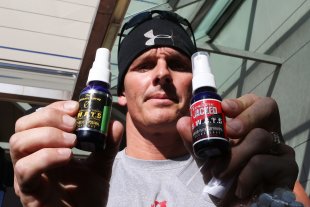
Mitch Ross speaks about The Ultimate Spray at Super Bowl XLVII. (Getty Images)But after determining that "The Ultimate Spray," the deer-antler product Lewis allegedly took, contains only "small amounts" of IGF-1, WADA announced it is not considered prohibited.


The athlete immediately impacted by the determination is golfer Vijay Singh, who had been sanctioned by the PGA Tour after he admitted using the spray in the same Sports Illustrated story. Upon WADA's determination, the PGA retracted its punishment of Singh.

"We're talking about a determination that was made by scientists at WADA that relate to the consumption through deer antler spray of a technically violative substance, IGF -1," PGA commissioner Tim Finchem explained this week. "But in looking at it, the scientists concluded it resulted in infinitesimal amounts actually being taken into the recipient's body."

The bigger question in the wake of WADA's decision is what this means for athletes and use of the spray going forward.

Yes, they can use it in the sense that WADA no longer prohibits it, and those athletes who feel it helps them can proceed. (An unnamed pro golfer told Jason Sobel of The Golf Channel, "I'm going on it as soon as I get home.")

But there remains a risk in that WADA still has IGF-1 on its banned list.

An email to WADA was not immediately returned, however Gary Wadler, former chair of the committee that determines WADA's banned list, told Yahoo! Sports, "Growth factors are a very significant issue in performance enhancement."

So it's sprayer beware. Use of "The Ultimate Spray," a product sold by a former bodybuilder named Mitch Ross, will likely not trigger a positive test, though use of IGF-1 is still not permissible. Much like speeding on the highway, IGF-1 is not permitted … but you can probably get away with it to a point.

"We ban and test for substances, not products," NFL spokesman Greg Aiello said in an email to Yahoo! Sports. "IGF-1 is on our banned substance list; same as it is on WADAs."

Confusing? Definitely.

The bottom line, though, is that more athletes will likely take their chances with the spray, even though it's still not clear how well it works, or even if it works at all. Athletes are always looking for an edge of any sort, and here's one WADA has cleared. The hard truth is that even if the spray was loaded with IGF-1, there's no widely accepted urine test for it anyway.

"There is only a blood test for IGF-1" Aiello said, "and the [player's] union has refused for two years to begin testing for growth hormone as it agreed to do in the new CBA."

And here's the major problem with both IGF-1 and HGH: We still don't know who's using because we still don't have blood testing in pro leagues like the NFL. On Tuesday, Tyler Dunne of the Milwaukee Journal Sentinel quoted an anonymous NFL player who said HGH use in the NFL is "like clockwork."

"Not tested and it's easy to get," the player said. "Nowadays, dude? In 2013? (Expletive] yeah. I'm just being real."

Ross has always dreamed of finding an alternative to steroids (hence the name of his company: Sports With Alternatives To Steroids, a.k.a. SWATS). When his spray became the focal point of a controversy leading up to Super Bowl XLVII, Ross flew to New Orleans to hold an impromptu press conference to "clear the air." Now he feels the WADA decision has lifted a cloud that's enshrouded him since the Sports Illustrated story came out and Lewis distanced himself from SWATS in the days thereafter.

On Wednesday, Ross said he felt "vindicated." He also said he's working with two new clients: Evander Holyfield and Mike Tyson. His website has videos of both boxing legends talking about the benefits of SWATS products, including the deer antler spray.

"If it didn't work," Ross said of his spray, "wouldn't it just go away?"

Blood Brothers: Greg Norman Has It Right on Drug Testing


Blood Brothers: Greg Norman Has It Right on Drug Testing


Ryan Ballengee May 2, 2013 1:04 PM


COMMENTARY | Drug testing in golf is a joke.


No, not the notion of it. That's completely kosher. However, the PGA Tour's drug-testing policy -- adopted and enacted five years ago this July -- does not go far enough to test for performance-enhanc
ing drugs.


Greg Norman suggested the same thing this week, saying the PGA Tour must go further to ensure its players are indeed good because of their raw talent, not thanks to a needle injected here and there.


"You only have to look at what happened to Vijay Singh just recently to know the drugs issue is there," Norman told The Australian newspaper.


Singh, for his part, admitted to Sports Illustrated in a Jan. 28 piece that he had taken a substance known as deer-antler spray, which purportedly contains a growth hormone, called IGF-1, banned under the PGA Tour's anti-doping program. For three months, no decision came from the PGA Tour on what punishment Singh should suffer for a tacit admission of breaking the rules.


Could it be a suspension? A fine?


On Tuesday, PGA Tour commissioner Tim Finchem laid down the law on Singh. Well, he was supposed to anyway. Instead, Singh was determined to not have violated the anti-doping program, allowing the 50-year-old Fijian to keep on playing as though nothing happened.


How could this be? After consulting with the World Anti-Doping Agency, whose guidelines served as the basis for the PGA Tour's policy, it was determined Singh's admission to using the deer-antler spray was not enough alone to sanction him.


WADA told the PGA Tour it does not consider deer-antler spray a banned substance and that only a positive (blood) test for IGF-1 should result in penalties. Ingesting any form of IGF-1 orally would not produce a positive test anyhow; it needs to be injected.


To summarize: Singh admitted to breaking the rules, but the rules were then retroactively changed to allow the three-time major winner to escape penalty because the PGA Tour does not conduct the kind of testing required to prove if Singh really did break the rules.


QED, Norman had it right.


If the PGA Tour did conduct blood tests on its players, rather than the urine samples it currently does (predominantly at tournament site), there is a better chance Singh would have been caught. Maybe he is suspended. Then again, under the policy the commissioner can choose to not suspend a player who has violated the policy. It's the performance-enhancing-drugs equivalent of Tiger Woods and Rule 33-7 from the Masters.


The PGA Tour must do several things in the wake of this protracted incident.


First, it has to take up Norman's suggestion that blood testing be the standard for its anti-doping program. What difference in discomfort is there in drawing blood than collecting urine? If it means the PGA Tour can actually test for all of the substances it says are banned, very little.


Second, it must test more often, away from tournament site, when players are not competing. In a February 2013 New York Times piece, Woods said he has never been tested off-site by the PGA Tour. The same claim was made by the likes of Rory McIlroy and former world No. 1 Luke Donald. With top stars taking lengthy breaks during the season to recharge for important stretches, an occasional knock at the door from a drug tester would improve the program's perceived credibility.


Finally, it has to appoint an independent arbiter to manage the program -- including doling out penalties -- and remove commissioner Finchem from the role. Golf's anti-doping program deserves an ombudsman (no pun intended) that is not working for the players, but rather to uphold the game's noble reputation.


In almost five years, the PGA Tour's anti-doping program has identified a single player, Doug Barron, with a positive test and followed through with an announced suspension. Ultimately, Barron's case was adjudicated to his satisfaction outside of the program's guise.


Basically, the anti-doping scorecard reads: five years, no positive tests. That means one of two things: (1) golfers are pristine and have no temptation to take a banned substance, or (2) some cheaters have been allowed to slide. It's likely the latter, even if somewhat unwittingly.


Heck, if Tiger Woods -- who said "rules are rules" -- can't remember the regulations around a simple drop, how likely is it that Vijay Singh isn't the only player to accidentally ingest a substance that might help him make a few more bucks every week?


Ryan Ballengee is a Washington, D.C.-based golf writer. His work has appeared on multiple digital outlets, including NBC Sports and Golf Channel.

My Blog List